

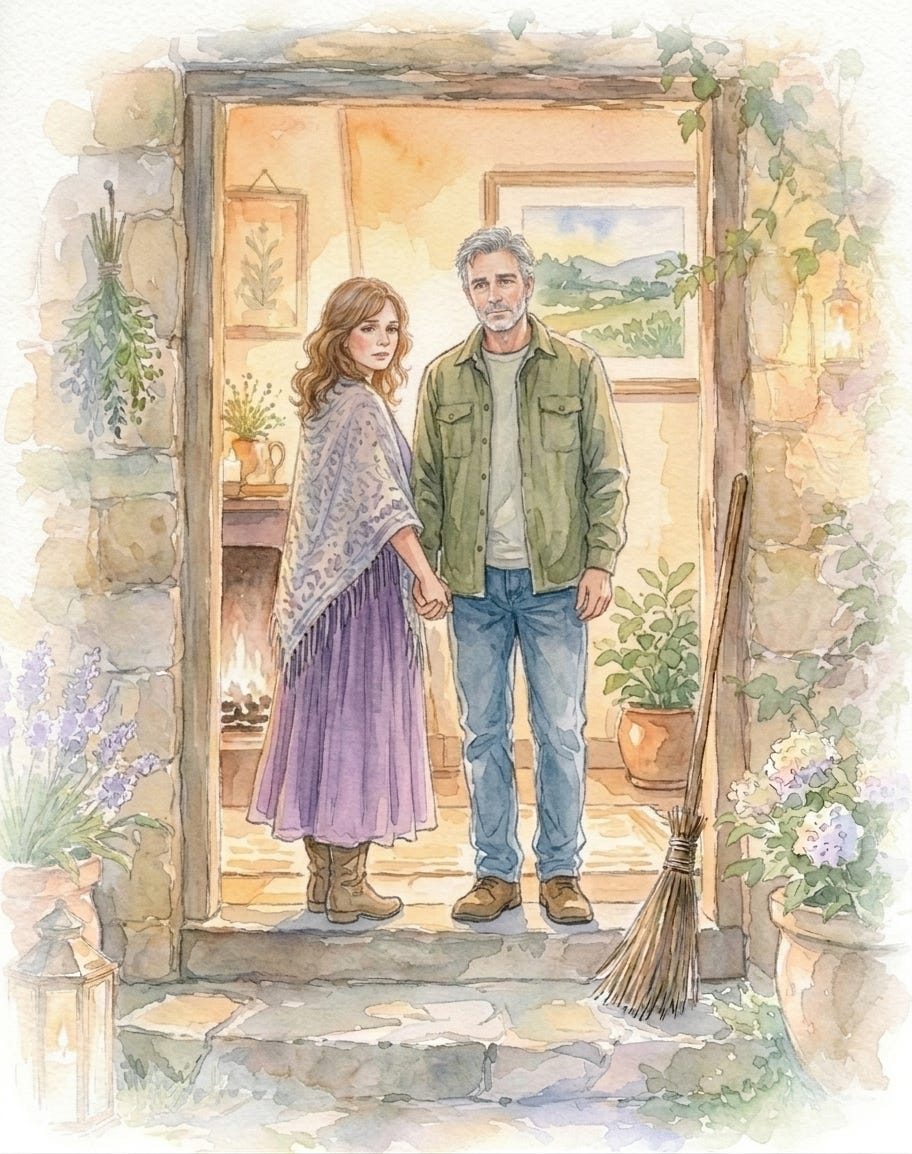
As a witch, taking the first steps in this unfamiliar territory of caregiving, I’ve wondered where my Craft fits in and how it might help carry me through this difficult time. Witchcraft goes only so far in the face of everyday tasks, sleepless nights, frequent crisis situations, and feeling helpless.
We often think of caring for a loved one approaching the transformation of death, as something one person does for another. In becoming a caregiver for my husband, I’m finding out it’s so much more than that. Caregiving has become its own threshold. We enter this journey together, knowing each will be transformed in different ways.
I’m reminded of the modern tradition of a groom carrying his bride over the threshold, juxtaposed with the older, cultural folk tradition of jumping the broom. Both symbolize leaving one life behind and stepping into another, but they express different acts of love—being carried, or walking forward together.
I know my Craft will offer no miracles. Magick cannot make a loved one’s illness disappear, or even make the caretaking easier. Yet, there is healing to be found in simple spells and rituals—the intentions stirred into tea with honey for soothing a throat dried by medication, or the comfort of herbal salves massaged into aching muscle and bone.
These small acts matter. The spells, the rituals, the kitchen witchery, they are love made visible. They are not powerless simply because they cannot cure. Rather, they are powerful because they remind us that love can still move through our hands even when our hands cannot fix what is breaking.
I’m beginning to understand that the deeper work of caregiving is found in changing the way we travel through this liminal space together.
In entering the cauldron of caregiving, my spouse and I are both submitting to transformation by the fire—one crossing the threshold into the sacred mystery of death, and one remaining behind, emerging from the flames with the hard-won wisdom of the Crone.
Witchcraft cannot carry me over this next threshold, no more than I can carry my husband into the next realm. But it can give me the strength to walk beside him until I must let him go.
All that’s required of me is answering the question, “What does my Craft ask of me today?”
Naming The Shadow
There is a shadow side to everything and caregiving is no exception. Perhaps nobody understands better than a witch that what is burried eventually demands to be unearthed.
But it seems nobody wants to admit this darker aspect—I’m talking about the anger.
Maybe it’s anger at the universe, the circumstances, the bad luck that strikes a loved one with illness. Maybe it’s anger directed inward, for not being able to fix everything, for being impatient, or for getting frustrated when certain cares are met with resistance.
I’ve judged my selfishness for wanting an afternoon of freedom, one day without crisis, or a good night’s sleep. I’m sometimes irked by the level of care I’m expected to give, especially when I feel the disease taking him away is the consequence of his own lifestyle choices.
I can’t always stop the gall from rising in my throat when I have to swallow that bitter pill of anger, tasting the guilt that lingers. If you’ve ever felt the same, know you are not alone.
But it’s then I return to one of the foundational beliefs of my Craft, Unwanted consequences can indeed arise from choices, but they also find us through no fault of our own, by the random chaos of chance.
We all make poor choices in our lifetime. It doesn’t mean we should have to bear our suffering alone. In the bigger picture, wisdom lies in knowing that it doesn’t matter if we’ve found ourselves in this space by fault or misfortune—the reality of each day would still be the same.
Judging myself for feeling anger and frustration just adds more weight to what I’m already carrying.
Then there is the biggest taboo of all, the one thing no good caregiver is supposed to feel. The wish in my darkest nights, that all this could just end. Not him. Never him. But the weight of it all. The ambulance trips, the hours in ER, the hospital stays and battery of tests, adjusted medications, new side effects, more medications. Watching the man I love shrink, physically and spiritually. Love asks us to bear all of it. The grief of not wanting to lose him, and the wish for the pain, both his and mine, to be over. Both can be true at the same time.
I reassure myself that feelings aren’t actions; that when I have to help him with buttoning a waistband, or steady him when he walks, I’m overcome with a kind of love I’ve never known before.
When he has good daysand we can still laugh together. When we can dance in each other’s arms, even if it’s just for one song. When I watch him sleeping, breathing easy, no part of his body twitching in pain, I wish that time could stand still, would just allow us to remain here forever.
If each morning I were asked whether I accept the sacrifice of caregiving, if it meant he would live one more day, my answer would be yes. I know I won’t abandon him. I will always be there when he needs me.
But even being there has come to mean something sharper than comfort. It also means vigilance. Holding his hand, yes, but also being the one who steps up when an ER doctor isn't listlistening. Being the extra set of eyes when a specialist can't see beyond the boundaries of their own expertise.
Because as any caregiver will tell you, it's not always the cancer, the lung disease, the heart failure, or whatever life-ending diagnosis has become the center of your world. Sometimes it's a virus, an infection, or heartburn—something ordinary, something treatable, but when overlooked it adds to his misery, and may even hasten death.
This is when I know exactly what my Craft asks of me; to understand that none of the anger or resentment lurking in the shadows of my exhaustion, unmet needs, or anticipatory grief reveal any less love in the reckoning, nor any less fight when called for.
The deeper truth is that we earn our wisdom when we give ourselves the grace to be human. A caregiver is not forged by never feeling frustrated, impatient, burdened or angry. We are forged by letting the fire burn our doubts to ash until what remains of us is tempered—standing guard, fully present in the moment.
The Act of Remaining
Caregiving is like a thief in the night. Friendships become harder to maintain, dreams are postponed, hobbies will be abandoned. Little by little it steals you away if you don’t protect your boundaries. This is how remaining begins long before the final moment.
Perhaps it’s a few quiet minutes with your morning coffee, time in the garden, or tending your houseplants. Making a call to a friend, walking in the moonlight. Or just taking a deep breath to summon yourself back each time you feel you’re slipping away. These small rituals are ways of remembering that you are still a whole person, not merely the role you’ve assumed.
My husband and I have entered the same cauldron, but the fire asks something different of each of us. While he is preparing to let go, I must prepare to stay behind.
He is surrendering certainty, independence, the body he once trusted. We are both surrendering control over the outcome. Neither path requires less courage than the other.
All I can do is to keep answering the question, What does my Craft ask of me today? This hour? This moment?
Make the tea
Set the boundary.
Speak the difficult truth.
Bite your tongue when silence is kinder.
Hold the hand.
Forgive.
Forget.
Remember.
Begin again.
Beginning again is a vow made new every day—in sickness and health, until death do us part.
When I fell in love and was ready to marry, my mother had one question for me: “Are you willing to wash his dirty socks and underwear for the rest of your life?”
Love is not found in grand gestures. We find it in the everyday things we do for each other. We fold it into clean laundry, stir it into the food we prepare. If we’re lucky enough to reach old age, it becomes organized pillboxes, whispered encouragement, and the familiar rhythm of yet another day shared side by side.
My parents enjoyed 64 years together, living independently until the end. Mother walked on first. When my father chose the headstone they would one day share, he had engraved a single line from their favorite song: We’ll stroll hand in hand again*. Nine months later, he joined her in their next journey together.
There comes a point in every love story when one person can no longer walk beside the other. Caregiving is teaching me that. It’s also helping me understand that walking beside someone for as long as you can is its own sacred act.
Love does not always get to choose the length of the journey, but it will choose how we walk it. I cannot cross this next threshold with my husband, but I can walk beside him, hand in hand until the end. It may not be the kind of love that changes worlds, but it’s the kind that means the world to him—and to me.
That is no small enchantment.
Until next time ~
Blessed Be and Journey Well
*Lyric from Blue Eyes Crying In The Rain, written by Fred Rose in 1945

If you enjoyed this post, you can help me build a community of heart-centered and spirit-led agents of change—by liking, leaving a comment, restacking on substack, or sharing a link on social media.
Simple Witchery for Everyday Enchantment remains free to all subscribers.
If you’re feeling generous, you can always show your appreciation by buying me a cup of coffee. Just click the image below.

I really appreciate you sharing your journey through this lens. I can't imaging going through what you're going through but as someone who has been searching for something to give me a sense of meaning and purpose, especially during hard times, it's encouraging to have an example of witchcraft supporting one of the hardest life struggles anyone could have to face. We don't often expect to look for and find the craft there, and we aren't shown these harsher moments in witchy feeds. Thank you for your vulnerability. I see your strength.
Sending you such deep love on your journey ❤️🩹